Which Automation System Suits Which Luxury Home
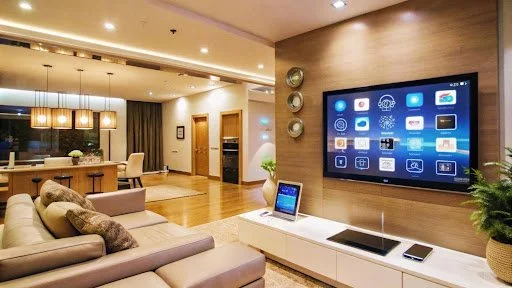
Four names cover the overwhelming majority of professionally installed automation in high-end residential projects. They are not interchangeable, they are not competing for exactly the same job, and the most common expensive mistake is choosing one on the strength of a showroom demonstration rather than on the shape of the project.
Here is what each is actually for.
Crestron: Built for Complexity
Crestron is the oldest of the group and remains the reference standard at the top of the market, particularly on the largest and most technically demanding installations.
The platform effectively splits in two. Crestron Home is the residential-oriented system, designed for faster configuration and a more templated setup, and it has matured considerably as a product in its own right. Above that sits the 4-Series line with full bespoke programming, which is where genuinely unusual requirements get solved: estate-wide control across multiple buildings, plant rooms with custom interlocks, wine cellars, pool systems with safety logic, anything where the house needs behaviour that no driver ships with.
That depth is the reason it costs more and the reason it takes longer to commission. It is also why the specialist matters as much as the platform. An installer who programs luxury home automation systems on Crestron is doing work that is closer to software development than to device configuration, and the quality of the result depends heavily on how much thought went into it rather than on the hardware in the rack.
The honest counterpoint: for a straightforward six-bedroom house with conventional requirements, that capability may exceed what the project needs.
Control4: The Volume Platform
Founded in 2003, a generation after Crestron, Control4 built its position on accessibility. It is quicker to install, faster to commission and less expensive for an equivalent specification.
Its architecture is modular and driver-based rather than programmed line by line, which is the source of both its strengths and its limits. Device support is broad, integrators can build bespoke layouts without writing code, and the dealer network is large.
The trade-offs are real. The interface is dated in places, and future changes route back through the dealer ecosystem, which matters more than people expect over a fifteen-year ownership period.
Savant: Interface First, and Now Energy
Savant's distinguishing strength has consistently been the end-user experience. Among integrators the consensus is that its app is the best in the category by a clear margin, and if how the system feels day to day is the client's priority, that carries weight.
The company has also moved somewhere the others have not. Following its acquisition of GE Lighting in 2020, Savant pivoted heavily into energy, and the Savant Power System now covers battery storage, solar, generator integration and intelligent load management.
For a project where resilience and energy management are part of the brief, that is a genuinely different proposition rather than a marketing distinction.
Lutron: A Layer, Not a Rival
Lutron is frequently listed alongside the others and does not belong in the same category. The company has been exclusively focused on lighting and shading since 1961, when it invented the solid-state dimmer, and it does not attempt whole-home control.
What it offers instead is depth in one domain: dimming curve quality, keypad feel, RF reliability and product range. HomeWorks QSX sits at the top for large residential projects, RadioRA 3 covers substantial homes below that, and Caseta serves smaller installations. Palladiom keypads exist for architecture that wants low-profile metal or glass, and Ketra addresses tunable white and colour rendering where lighting design is part of the brief.
From an interiors perspective this is the layer that most visibly affects how rooms feel, because dimming behaviour and keypad appearance are what occupants actually experience.
What Serious Projects Usually Do
The pattern that recurs on the most capable installations is not choosing one brand. It is Lutron for lighting and shading, with Crestron, Control4 or Savant as the control brain that orchestrates everything else.
That combination costs more than a single-vendor approach and is widely regarded as the right answer for demanding projects, because it lets each platform do what it is best at. Once lighting is settled as Lutron, the comparison between the control platforms becomes much cleaner: they are no longer being asked to design the lighting, only to coordinate scenes around it while handling audio, video, climate, access, gates, pools, cameras and remote access.
Voice Sits On Top, Not Underneath
Josh.ai occupies a different position again, layering natural-language voice control over whichever platform is underneath. It handles conversational instructions and status questions in a way the generic assistants generally do not.
Worth understanding that it is an addition rather than a foundation. Voice is a convenience layer, and specifying it as the primary interface for a house is a decision most integrators will push back on for good reasons.
The Layer Nobody Puts in the Brief
A connected house is a large number of internet-facing devices, and the network is part of the automation design rather than something handled afterwards by whoever configured the Wi-Fi.
The Federal Trade Commission's consumer guidance on securing your internet-connected devices at home makes the central point simply: the router is the key to privacy in a connected home, since everything connects through it, and default settings need changing.
The Commission's enforcement record shows why this is not theoretical. It has brought cases against a smart lock manufacturer over claims its internet-connected locks were "unbreakable" and over the security of the data it collected, and against a device maker whose router and camera vulnerabilities left live video feeds exposed to third parties.
On a high-end project, segmented networks, controlled remote access and a defined responsibility for firmware updates should all be specified at the outset, whichever platform is selected.
Decisions That Cannot Wait for Second Fix
Whichever direction you go, several things are effectively irreversible once plaster is on.
Cable routes come first. A centralised system needs home runs from each load back to a rack position, which is a different first-fix approach from conventional wiring and cannot be retrofitted without opening walls.
Rack space is the most frequently forgotten item. These systems need a ventilated cupboard with power and cooling, not a shelf in a wardrobe.
And the scope decision matters: adding shading, HVAC or access control later is possible but far more expensive than running the cabling now and commissioning those elements in a later phase.
Who Holds the Project File
One question separates a system that stays useful from one that quietly ossifies, and it is rarely asked at the design stage.
Every programmed installation exists as a project file held by the integrator who built it. Firmware updates, a new device, a reconfigured scene after the furniture changes, a family member added to the access list: all of it requires someone with that file and the software to open it.
Ask before signing who holds it, what a service agreement covers, what response times look like, and what happens if you want to change integrators in year six. Those answers shape your experience of the system more than the specification sheet does, and they are considerably easier to negotiate before installation than afterwards.
Choosing Without a Demonstration
The useful questions are not about which interface looks better.
How complex is the logic this house actually needs, and does anything about it fall outside what standard drivers handle? Is energy management part of the brief? Who will maintain this in five years, and does that person have access to the project file? And how long do you intend to own the property, since the calculation differs sharply between a long-term family home and a five-year holding.
Answer those four honestly and the platform choice usually makes itself. Answer none of them and you will end up with whichever system your integrator happens to be certified in, which is sometimes the right answer and is never a decision you actually made.